|
|
This page should actually be called Witches and Sibyls.
Below are some articles on wise-women that are found in Norse myths, which included: witches, sorceresses and prophetesses.
|
| Background | ||||||
|
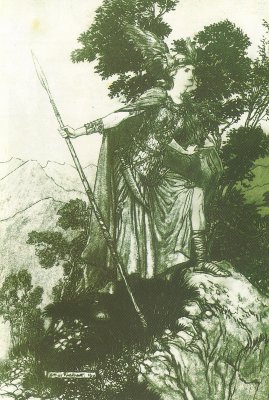
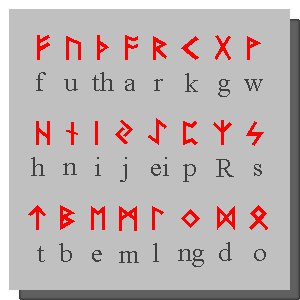
Magic and witchcraft was often used in Norse mythology, not just among mortals. The gods and goddesses also resorted to sorcery. The Vanir Freyja was the goddess of witchcraft, as well that of love, fertility and war (see Vanir, Freyja). She practices a brand of witchcraft known as seið. She was said to have brought seið from her homeland, Vanaheim, the world of the Vanir, to Asgard. The Vanir was a different tribe of gods to the Aesir. Seeress or sibyl, on the other hand, were called völva (singular), or völur as plural. They were responsible for divination, such as oracle and prophecy, or other methods of divination. Men who are involved in divination, such as soothsayers or wise men, were called vísindamenn. According to Song of Hyndla 33 (Hyndluliod), Svarthofdi was ancestor of witches and all seeresses were descended from Vidolf. In the Icelandic saga, Eiriks Saga Rauda, the seeress, Thorbjörg had earned the title of líilvölva, which means little sibyl, thus was called Thorbjörg líilvölva. Magicians and wizards called galramenn, which is translated as "sorcerers". Both Eddas are rather vague about the seið. In the Icelanders' saga, called Eiriks Saga Rauda, we are given an insight of how seið is performed, in the account of the Greenland prophetess Thorbjörg líilvölva. Thorbjörg required a young woman named Gudrid to help her call upon the guardian spirits. Gudrid drew a circle around Thorbjörg, and then chanted the guardian songs, known as Varðlokkur. So seið was probably a form of incantation or singing. Odin was the only male god to use this seið; seið seemed to be restricted to women and goddesses. But Odin had not only used seið. Odin was also the master of runic magic. The use of rune can be used to create powerful wards. Rune magic was not restricted to certain gender. Odin was the lord of Valhalla, the hall of the dead heroes. He has the Valkyries serving him, choosing the warriors slain in battle. The Valkyries also possessed powers to use runic magic. There is a separate page for the Valkyries. The Valkyrie Brynhild (or Sigrdrifa in Sigrdrifumal) knew of the magic using runes, which she revealed to the hero Sigurd; see Brynhild. In Norse myths, the names of witches are not always given. Some witches are benevolent, while others are malignant. One nameless sorceress helped the heroine Signy, so that the heroine would look like the witch. Signy changed shape so that she could sleep with her brother Sigmund, and bear a son Sinfjotli, who would be strong enough to help her with revenge against Signy's husband. See Sigmund and Signy in the Volsunga Saga. In Havamal 113 (from Poetic Edda), Odin warned Loddfafnir that –
Also in Havamal, Odin tells Loddfafnir that he knew of eighteen spells. For more about Odin and his magic, read the Search for Wisdom. |
|
|||||
| Teutonic Wise Women | |||||||||
|
Before I list articles on sorceresses and prophetesses, I should perhaps begin with witches that were celebrated among the ancient Teutonic people. These ancient Germanic prophetesses were mentioned by the 1st century Roman historian, Tacitus. Their names were Veleda and Aurinia, or Albruna. The ancient Germans also venerated Aurinia, or Albruna, and many other women. The Teutonic chieftains and warriors never ignore the words from any seeress. In fact, Tacitus says that the Germans listened to the advice of women, regardless if they were gifted with divination or not, because they sincerely believed that all women have certain sanctity and prescience. Veleda was a 1st century prophetess, living at the time of Vespasian. She was so revered that her tribe had actually worshipped her as a goddess. Veleda lived in a high tower, and pronounced her prophecy on a raised platform, where no one was allowed to approach her directly. In the 2nd century AD, there was a Semnoni Sibylla, named Waluburg. This name is similar to that of Saint Walpurgis or Walburga (710-779), a Benedictine abbess, whose feast day is held on February 25. St Walpurgis has often been associated with the witches coven held on Walpurgis' Night at Brocken on Harz mountains on May Eve (April 30), where she was sometimes confused with another figure, a pre-Christian fertility goddess - Waldborg. |
|
||||||||
| Heid | |||||||||
|
According to the Voluspa (Poetic Edda), Heid (Bright One) was the reincarnation of the healing goddess Gullveig. She was sometimes confused with the Vanir goddess, Freyja. As Gullveig, she was the Vanir goddess, whom the Aesir attacked with their spears, and burned her three times in Odin's hall, but each time she was reborn.
The attack upon Gullveig triggered the war between the Aesir and the Vanir. More about Gullveig and Heid can be found in the Vanir page. There are other witches named Heid in Norse myths, but these women are mortals. In the Saga of Hrolf Kraki, there was a seeress, named Heid, who does all her foretelling on a raised platform in King Frodi of Denmark. She saw that Frodi's nephews, Helgi and Hroar, would avenge their father's murder; it was Frodi who murdered his own brother, Halfdan, because Frodi wanted his brother's kingdom. There is also Heid in Landnamabok and in Orvar-Odds Saga. |
|
||||||||
| Groa | |||||||
|
Sorceress and a sibyl. Groa was wife of Aurvandil the Bold. She appeared in the Prose Edda, in the myth where Thor fought the giant Hrungnir. Though Thor had killed the giant with the Mjollnir, piece of Hrungnir's whetstone was lodged in Thor's head. Groa was using her magic to remove the piece of the whetstone, but the grateful Thor distracted the sorceress with news of her husband's whereabout. Thor had helped Aurvandil in crossing a freezing river of the Elivagar, whom the god was carrying in a basket, but one of Aurvandil's toes froze into ice, when his foot dipped into the water. Thor broke the toe off, and threw the toe into the sky, where it became a star. Thor told her that Aurvandil was now at her home. Groa's spell went awry from the distracting news, so the whetstone became permanently stuck in Thor's head. See Giant of Clay. According to the poem Gróugaldr, Groa was the mother of the hero Svipdag (Svebdegg). Her son used a spell to raise her from her grave, where Svipdag could learn how he could successfully woo the beautiful Menglöd, whom he must win in a dangerous quest. The tale of Svipdag's quest for Menglöd can be found in another poem called Fjölsvinnsmál. Svipdag found Menglöd in the castle on top of a mountain, where she was surrounded by a ring of flame, and guarded by giant named Fjolsvinn. |
|
||||||
| Borghild | |||||||
|
Sorceress, who was particularly skilled with poison. Borghild was the first wife of the hero Sigmund, king of Hunland. She was the mother of two sons, Helgi and Hamund. Though, her stepson, Sinfjotli, the son of Sigmund and Sigmund's sister, Signy, had helped her own son to win the war against the Hundings, she was jealous, because Sinfjotli was first born. She was determined to kill her stepson. She tried to poison Sinfjotli. Borghild passed poisoned wine to her stepson, but Sinfjotli recognised it as poison. Sigmund would take the wine cup from his son, and drink the poison himself. Such was Sigmund's constitution that he was immune to all poison. The second cup she passed to her stepson was also filled with poison, and Sigmund drank this too. By the second cup, Sigmund was quite drunk, and told his son to drink the third cup that Borghild gave to Sinfjotli, if he was not a coward. The moment the wine passed through Sinfjotli's lips, he died. Odin had personally taken Sinfjotli's body with him, to Valhalla. Sigmund drove her out of his kingdom for murdering his son. Borghild didn't live long, after she was banished. |
|
||||||
| Grimhild | ||||||||
|
Queen and sorceress. Grimhild was the wife of Giuki (Gjuki), king of the southern Rhine, Burgundy (Niflungland). She was the mother of three sons - Gunnar, Hogni and Guttorm - and of one daughter, Gudrun. In the Icelandic legends, Grimhild was the main adviser of her husband and her sons when they ruled the kingdom. She was partly responsible for the tragedy that would befall in her family. She was a very ambitous queen, who used her children, particularly her daughter to further the house of Niflungs, without giving thought to the consequences of her actions. It was she who gave draught of forgetfulness to Sigurd so that the hero would forget the Valkyrie Brynhild, and marry her own daughter Gudrun. It was Grimhild who advise her husband that Sigurd should marry her daughter. With such powerful son-in-law, her sons could not lose any wars they fought against their neighbours. Not only would her family gained power, but also increased wealth from Sigurd's dragon treasure. It was also Grimhild who proposed that Sigurd would help Gunnar to win Brynhild. Since Gunnar could not ride through the ring of flame surrounding the sleeping Brynhild, they used her magic so that Sigurd and Gunnar could change shapes, so they would look like the other person. Sigurd rode through the flame, disguised as Gunnar. It was only after Gunnar married Brynhild that he remembered that he was betrothed to Brynhild before he had ever met Gudrun. When Gunnar and Hogni plotted to murder Sigurd, because Brynhild demanded it from her husband, it was Grimhild who had mixed drink of snake and wolf flesh that would imbued her younger son, Guttorm, berserker rage to murder Sigurd. Both Guttorm and Sigurd ended up killing one another. With Sigurd's death, her sons gained the treasure of Fafnir. Further tragedy would follow, because of Grimhild's machination. She used her draught of forgetfulness again, but this time she gave it to her daughter, so that Gudrun would forget her grief over Sigurd's death and forgive her brothers. She then later urged coerced Gudrun to marry Atli, brother of Brynhild. Gudrun pleaded with her mother that she have no wish to marry the treacherous king, whom she knew would be bring about the death of her brothers and many Niflung warriors, but Grimhild was adamant. After the marriage, Grimhild doesn't appear in the saga again. See Volsunga Saga. Her role in both Sturluson's Prose Edda and the poems in the Poetic Edda were the same as that of Grimhild in the Volsunga Saga - that of queen and a witch who meddled with Sigurd and her family, bringing downfall to all. In the Thidrekssaga, where she was known as Oda, or in the German Nibelungenlied, as Uote (Ute), she was not a sorceress. However, in the Thidrekssaga, Oda (Grimhild) does become the mother of Hogni, whose father was an elf. Apart from this, part concerning Hogni and her other children, she only played small parts, particularly her attempt at reconciliation between her daughter and her sons, and persuading her daughter to marry Attila (Etzel). Here, she used no magical drink for her daughter to make Grimhild/Kriemhild to forget Sigurd/Siegfried, which was vital in the Icelandic versions. |
|
|||||||
| Sibyl | |||||||
|
Prophetess. Sibyl was actually Latin name for several prophetesses that appeared in Roman legend. One of the Sibyls guided the Trojan hero, Aeneas to the Underworld to talk to his father, Anchises. Sibyl appeared to be a title, rather than a name. According to the Icelander Snorri Sturluson, Sibyl was another name for Sif. Sibyl (Sif) married Tror Thor. Despite the name, Sif doesn't appear to have any divination skill in the Norse literature. The first poem in the Poetic Edda, Voluspa, which was frequent translated into English as the "Sibyl's Prophecy". |
|
||||||
| Thorbjörg líilvölva | |||||||||
|
The prophetess in Eiriks Saga Rauda, a 13th century Icelanders' saga. Thorbjörg had earned the name líilvölva, which means "little sibyl", because she was known for her prophecies. Thorbjörg had nine sisters, and they were all prophetess, but they had all died by the time, she had visited the farming district of Herjolfsness in Greenland. Thorbjörg arrived in time to attend the winter feast and enjoyed the hospitality of Thorkel, the chief farmer of Herjolfsness. There's an interesting description of what she wore that evening. They gave her the seat of honour. After the meal, Thorkel and the other villagers were curious about their future, because they were in the midst of famine, but she refused to give them answer until the morning. The next day, Thorbjörg asked the people if anyone know the seið on the guardian songs, known as Varðlokkur. No one knew the incantation, except a young woman, named Gudrid, who had learned this from her foster-mother, Halldis. However, Gudrid refused to perform the ritual since she was a Christian. Since many people were suffering from the famine and illnesses, Thorkel pressured Gudrid into performing the seið, for the goods of the whole village. So while Thorbjörg sat on seiðhjallr - a raised platform with a chair, Gudrid drew a large circle around Thorbjörg and chanted the song (Varðlokkur). Once completed, all Thorbjörg finally disclosed what she knew of famine. Thorbjörg assured the villagers that the famine and illnesses would come to an end, when the last winter days have passed, because the guardian spirits have returned when they heard Gudrid's beautiful voice, when she was chanting. More importantly, the prophetess revealed Gudrid's own fate. Though the young woman would marry a man of distinguished family in Greenland, Gudrid would leave and go to Iceland, where she would be the ancestor of a great line. The Eiriks Saga Rauda gave us perhaps the most detailed account about the witches. Other sources are rather vague with their accounts. Thorbjörg líilvölva bear a remarkable resemblance with the 1st century seeress, Veleda, on the sort of reverence and respect witches and prophetesses received from the people. |
|
||||||||
This page belongs to Timeless Myths.
See Copyright Notices for permitted use.
For feedback, questions, or just to say "hello",
contact can made through the Contact page.
No mailing list or spamming, please.
Home | Norse Mythology | Asgard | Valhalla | Norse Sagas
What's New? | About | Bibliography | Fact & Figures | Genealogy | FAQs | Links | Copyright | Contact | Back
Copyright: Timeless Myths (Norse Mythology) © 1999, Jimmy Joe. All Rights Reserved.
First Created (Witches): 28/09/03.
Last Modified: 24/06/06.